Operational questions about the service
These are the questions I get most often about practical service details. For informational topics (costs, best season, documents, ceremony types) see the blog, which covers those in depth.
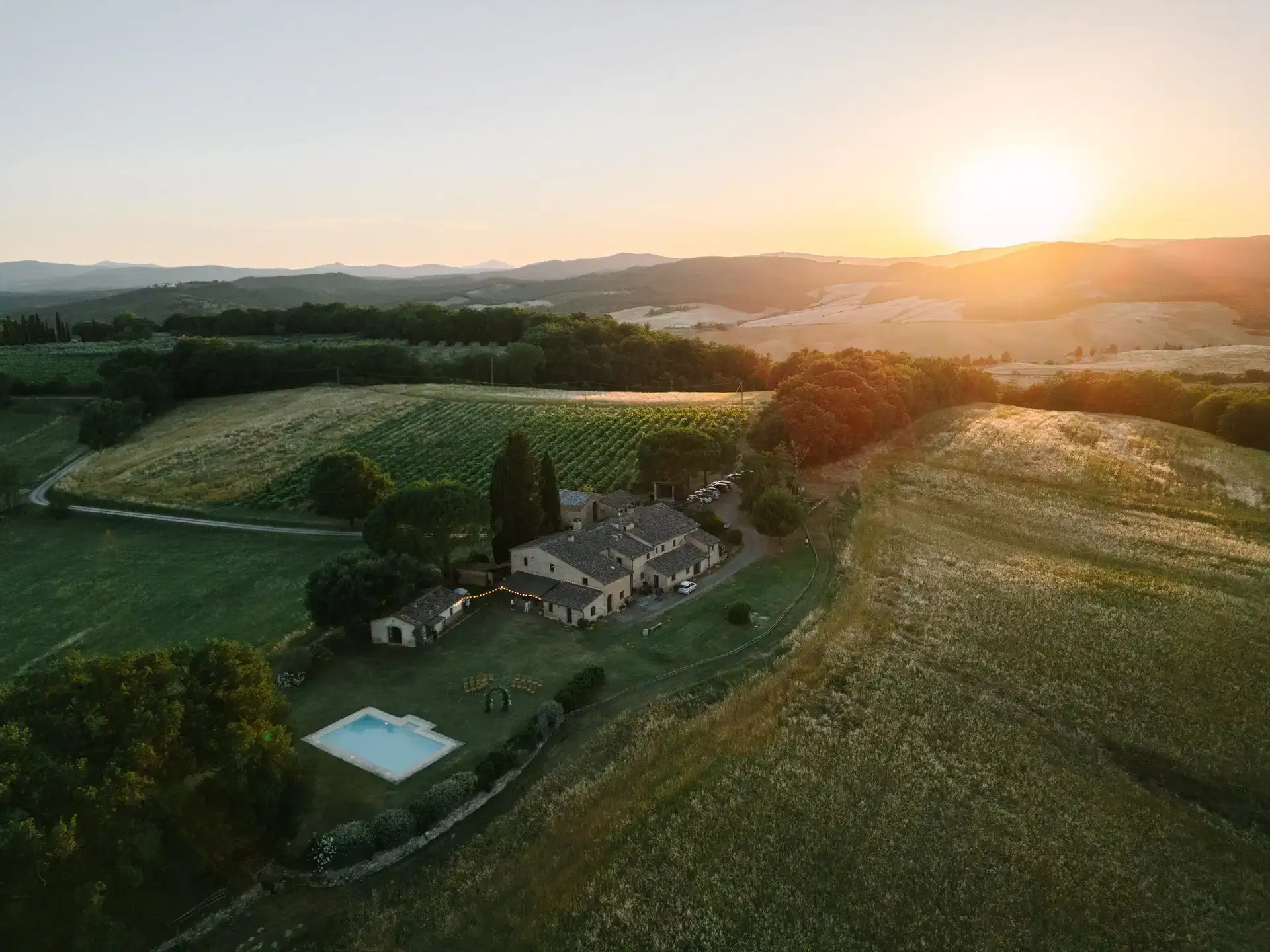
What you need to know before choosing: what is included, how we work together, what happens if it rains.
These are the questions I get most often about practical service details. For informational topics (costs, best season, documents, ceremony types) see the blog, which covers those in depth.
Full planning includes: initial consultation and budget setting, venue research, contract negotiation with all vendors, one or more site visits to the venue as needed, complete design (concept, colour palette, decor, stationery), management of legal paperwork for the chosen ceremony, and full direction on the wedding day. It does not include: venue and vendor fees (these are invoiced to you directly by the suppliers), or optional extras (an extended welcome party, brunch, pre-wedding events), which we cost out separately if desired. A detailed contract sets out clearly what is included and what is not, so there are no misunderstandings.
A wedding planner follows you from beginning to end: designs, selects, coordinates. A wedding coordinator steps in during the final month for a recap with the vendors, and is there on the wedding day to run a plan you've already built yourself. A venue manager represents the venue and handles only what concerns the physical space, not the other aspects of the wedding. I work as a full-service wedding planner, but I also offer coordination-only packages if you've already planned everything on your own.
During active planning (the last 3-6 months before the wedding) replies come within 24h on working days. In earlier periods we work with monthly scheduled emails and video calls. The week of the wedding I'm fully available on WhatsApp and phone. I work with a limited number of weddings per year precisely to guarantee this level of responsiveness.
Every project includes a Plan B for bad weather, agreed from the early stages of planning. We choose venues with covered alternatives that still look beautiful (indoor halls, gazebos, porticos, elegant marquees where needed) and we build a timeline with enough flexibility to move things around.
On the day itself I decide it with you, usually by midday, or earlier if suppliers and venue need the answer sooner. The call is made on the real forecast, not on a guess made three days before.
I work with a trusted network of vendors I've built relationships with over years: people I know well, whose quality and reliability I trust. If you already have a photographer (or other vendors) you absolutely want to bring, we evaluate it together: I try to be flexible, but the important thing is alignment with the project. For international weddings it's common for couples to bring their own photographer from abroad, I'm happy to work alongside them.
On the wedding day I arrive in the late morning, generally between 11 and 12 depending on the ceremony time, and I stay until the party is well under way. I'm not a planner who disappears after the cake: I stay for as long as my presence is useful and everything is running as it should.
Once the most intense part of the day is behind us and the celebration has started, I'll gladly stay for a drink with you if you'd like. And if you plan to dance until dawn, I'll leave you to it once I'm certain nobody needs me any more.
For multi-day weddings my presence extends naturally to whatever is planned before and after, from the welcome event to the brunch or anything else we arrange together.
Yes, more and more international couples choose a full weekend: welcome dinner on Friday, ceremony and reception on Saturday, farewell brunch on Sunday. For many guests travelling from abroad this format turns the wedding into a small shared trip. I can also design events distributed across different locations or experiences (winery tastings, guided tours, cooking classes) in the days leading up to the wedding. My service covers the wedding day itself. Additional events, such as a welcome dinner, a pool party, a pizza party or a farewell brunch, can be arranged on request and are quoted separately.
We collect all requirements (vegetarian, vegan, intolerances, allergies, religious) during the RSVP phase and share them with the caterer to build a menu that works for everyone. For couples with international guests we're used to handling kosher, halal and regional variations. All the caterers I work with have menu-personalisation experience: this is part of the standard service, not an extra.
It's a free, no-commitment half-hour video call. You tell me your idea, even loosely sketched, and I tell you about my approach, the planning process, and how we'd work together if you decide to proceed. There's no sales pressure: it's a conversation to find out if there's a good match. If we feel aligned, I send a personalised proposal within a few days of the call.
Yes, after the discovery call I send a detailed proposal with included services, the quote, financial terms and a draft contract. You have all the time you need to read it and ask questions before signing. There's no rush: I want both sides to make an informed choice.
The contract has specific cancellation and postponement clauses. If you need to postpone for force majeure (pandemics, serious family events) we work together to find the best solution, typically rescheduling without additional planning penalties. For cancellations the financial terms depend on when it happens and how much work has already been done. Details are always set out transparently in the contract.
For every wedding I have a senior colleague as dedicated back-up, who knows the project in detail thanks to a thorough handover we do in the final weeks. If for any reason I can't be present (rare, but it can happen) she takes over without the wedding being affected. It's a guarantee I believe every serious professional service should offer.
A maximum of 10 to 12 weddings a year. The number is deliberately limited: it's what allows me to give each couple the presence, the attention and the care I think this work requires.
It also means dates go quickly, especially for the most requested months (May, June and September). It's worth getting in touch early.
I work on bespoke, refined projects, and that requires an investment consistent with the type of service. For weddings with budgets significantly below my standard tier, I'm honest about it during the first call and, where possible, point you to colleagues better suited to your range. I'd rather be upfront than mislead a couple.
Absolutely yes. I've had the pleasure of planning weddings for same-sex Italian and international couples, both civil ceremonies (recognised as civil unions in Italy since 2016) and symbolic ones. I only work with locations and vendors who share values of inclusion and respect: this isn't an add-on, it's a baseline requirement when I select partners.
